The Domino Effect: How Separating QSR Sign Fabrication from Site Installation Compromises a Franchisee’s Speed to-Market
By Dan Julien | Julien Management Group
In high-velocity Quick Service Restaurant (QSR) real estate development, the timeline between ground-up delivery or tenant handover and the first drive-thru transaction is a race against capital burn. Every stakeholder knows that true project velocity depends on hitting strict tenant delivery windows. Yet, during the intense final push toward corporate handover, multi-unit franchisees frequently try to optimize line-item procurement costs.
One of the most persistent temptations in commercial retail development is to decouple specialized sign fabrication from site installation. The on-paper math looks incredibly simple: why absorb a national sign vendor’s logistics and field-management fees when your local General Contractor (GC) or a localized subcontractor can hang the hardware for less?
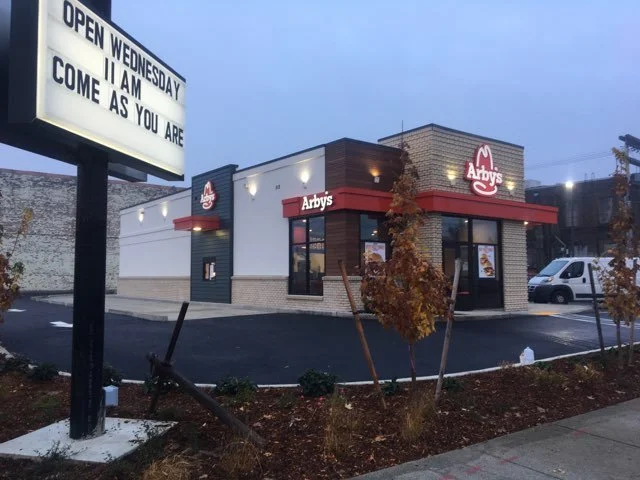
Figure 1: Finished turnkey QSR storefront implementation—where exterior pylons, directional boards, and building facades must sync perfectly to achieve structural and municipal compliance.
“The Real Estate Development Maxim: A QSR shell is just an expensive box until the brand assets are live. Every day a fully constructed building sits without its primary branding identity is a day of lost revenue, deferred brand awareness, and accumulated carrying costs.”
In practice, this decision triggers a severe domino effect. When a franchisee separates manufacturing from field execution, a minor technical variance that should be resolved with a quick phone call transforms into weeks of project friction, finger-pointing, and delayed store openings. In the institutional QSR space, where speed-to-market dictates your entire return on invested capital, it is an incredibly expensive mistake.
THE THREE-PART BREAKDOWN OF A FRAGMENTED SIGNAGE PROGRAM
1. The Illusion of Savings:
The Reality of the Financial Math Franchisees often evaluate a specialized sign vendor's turn-key installation quote against an unbundled field labor line item in their GC's contract. If the corporate-approved sign vendor quotes $3,500 for delivery, crane staging, and certified installation, and a local installer offers a flat rate of $1,500, the franchisee assumes they are banking a clean $2,000 CapEx optimization. This equation completely ignores the risk premium of a delayed store opening. In QSR development, a location that is fully built out, staffed, and paying rent—but cannot open its drive-thru lane because the exterior pylons failed a municipal code inspection or the building facade sign cannot be wired—is leaking capital. When a high-volume site sits dark, you are burning fixed overhead and losing thousands of dollars in highvelocity daily sales. A single week of project delays completely wipes out any theoretical procurement savings achieved by breaking up the vendor contract.
2. The Finger-Pointing Trap:
The Breakdown of Accountability Splitting fabrication and installation between two distinct entities completely eliminates clear operational accountability. Throughout my career in project management, I have seen this scenario disrupt site handovers repeatedly. A custom sign box arrives at the job site, and during unboxing or final fitment, an issue is discovered. Perhaps a premium acrylic face is cracked, an LED internal driver is dead, or the pre-drilled mounting brackets do not align with the structural blocking built into the building facade.
In a decoupled framework, an immediate blame game begins:
The Fabricator’s Stance: "The asset left our production floor in flawless condition. Your local installer must have forced the fitment, dropped the crate during offloading, or wired the transformers improperly— which instantly voids our manufacturer's warranty."
The GC / Installer’s Stance: "We handled the delivery with absolute care. The sign was fabricated out of spec right out of the crate, or the internal wiring was damaged before arrival. It is a factory defect, and we are charging a change order for the downtime."
3. The Single Point of Contact (SPOC) Strategy: Complete Protection
The only way to insulate a high-velocity rollout from this risk is a Single Point of Contact (SPOC) procurement strategy. Forcing your sign vendor to manage the asset from initial shop drawings through manufacturing, logistics, and final field installation establishes clear, single-source accountability.
End-to-End Warranty Protection: Because the same firm fabricated and installed the asset, there is no loophole to void the product warranty. They own the sign's performance from the factory floor until it is lit up on your building.
Instant Field Remediation: If an LED module is faulty or a piece of custom trim is missing upon arrival, it is the vendor’s internal problem to fix. Their field crew coordinates directly with their manufacturing plant to overnight parts or adjust the fabrication on-site.
Seamless Tenant-Landlord Coordination: Specialized sign vendors understand how to navigate complex landlord criteria, municipal zoning variances, and strict local electrical codes.
THE PROJECT MANAGER'S VERDICT
In franchise and real estate development, true efficiency is never about chasing the lowest cost for individual line items; it is about protecting the project timeline and minimizing risk. Your storefront sign is the primary visual driver of customer traffic and revenue. Treating it as a single, turnkey asset ensures that when opening day arrives, your location is fully branded, fully compliant, and ready to open.